Frequently Asked Questions
These are some of the questions I am most commonly asked at fairs and open studios and on social media, but if there is anything you want to know that isn't covered here, please do get in touch. (Please note the answers I have given here relate specifically to my own practice - other printmakers with different printmaking methods may vary!)
What is a reduction print?
A reduction print is made using a single block of lino or wood which is progressively carved away to create the printing area for each layer of a multi-layer image. There's a more detailed explanation here.
How long does a print take you?
On average I complete one print edition a month.
Why does it take so long? Isn't printing really quick?
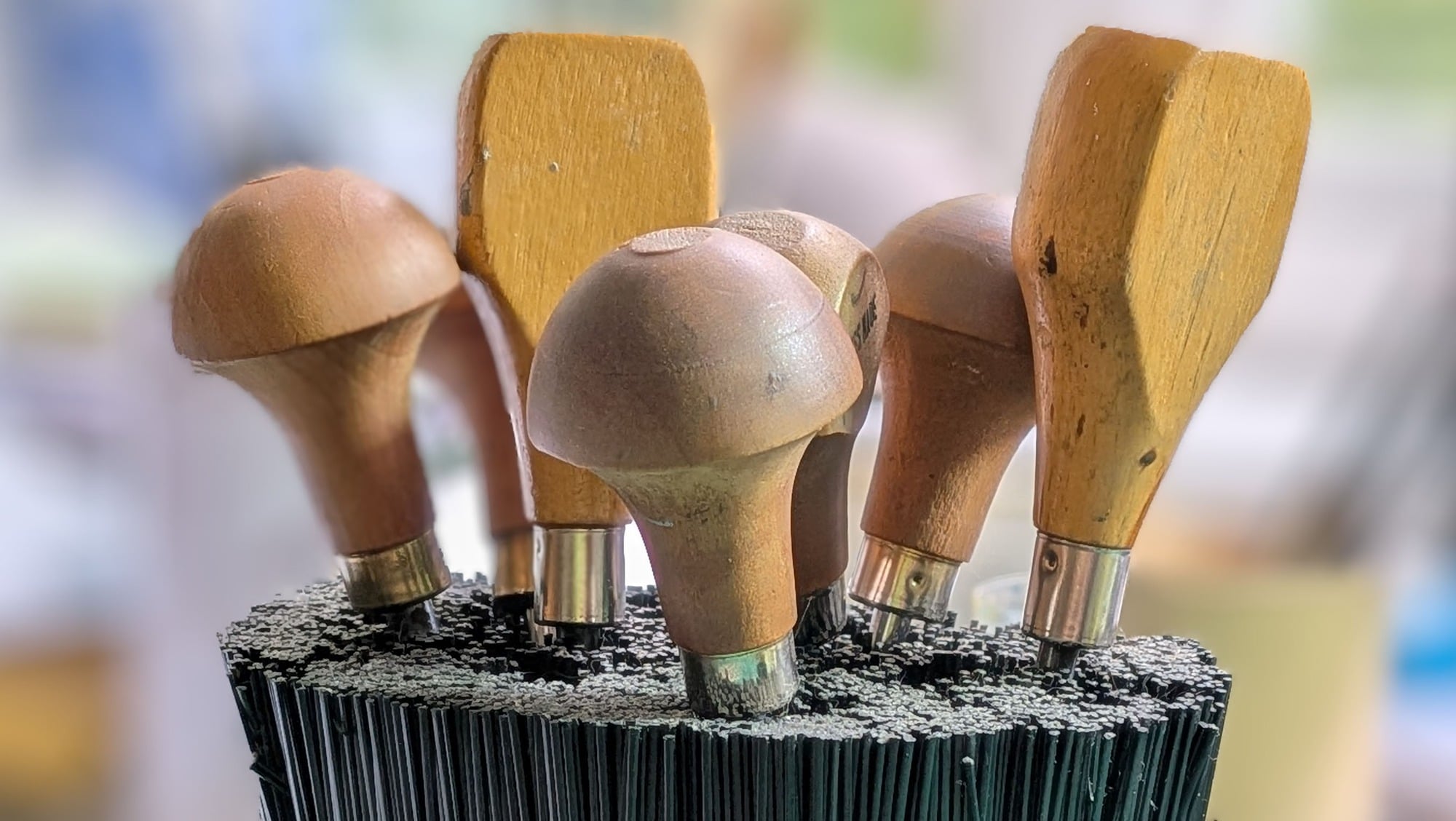
Transferring ink to paper with a press is very quick, but that is only one tiny part of the process. Each of the many layers in a print involves first carving the block using fine tools and then inking the block and printing. The block is inked from scratch by hand for each print, or 'impression', in the edition. In between the carving and printing there is also the drying time between each layer (from one to several days), plus of course the time spent planning, designing and problem solving, working out how the successive layers must be arranged to achieve the final image. Before all that there is the time spent preparing the paper, lino block and the registration jig which ensures the paper and block line up correctly for each printing.
What do you mean by registration?
The paper must be placed back on the block in exactly the same position for each different layer, otherwise the image will appear blurred and out of focus. Achieving this is called registration.
The print I wanted is sold out. Will you be doing some more?
Reduction prints cannot be repeated because the block is destroyed in the process of making the print. I might do another print that is similar but it won't be the same one. Print descriptions in the shop always say how many prints are in the edition and once they have sold that's it - they are gone!
Have you got this print in a different size?
Linoprints are made by hand from a carved block. They are not digital files that can be reproduced in different sizes. I might do a similar scene in a different format (for instance a simplified mini-print), but it will not be the same print.
What do the numbers written under a print mean?
Traditionally prints are numbered with the particular impression number first followed by the total edition number. So 2/10 means print number two out of an edition of ten. Sometimes you will see the letters 'VE' after this which stands for 'variable edition' - this means there are significant differences between prints in the edition (beyond the small variations which are the natural result of a handmade process).
Is print number one in an edition more special or valuable than the others?
The nature of reduction printing means that each stage of the whole edition is printed at once. When all layers are finished and dried, then by the time I have trimmed down the paper, checked for quality and chosen the prints to be included in the final edition, the pile of prints on my desk to be signed and numbered is unlikely to be in the same order that they were originally added to the drying rack. So print number one is almost certainly not the one that was printed 'first'! The numbering is purely to verify that a print is one of a limited edition - all the prints were finished on the same day, have the same history and are of equal value.
Your site won't let me place an order because I don't live in the UK; can I just pay the extra postage?
I'm sorry but the reason I no longer send orders abroad is not because of postage costs, but because of the increased regulations, administration and tax complications which have become a significant burden for small businesses. If you have a friend with an address in the UK then they could place the order and you could arrange its onward travel privately between you. (Please do not ask me to break the law by sending an order directly to you marked as a 'gift').
Are your prints of real places?
Yes they are all very real and my prints reflect my own experiences of them. Shop descriptions include an 'about this scene' section where the location is not already given in the title.
What sort of press do you use?
I use a number of different methods for transferring the ink from the block on to the paper, depending on the size and detail of the print and also the paper. My biggest press is a large roller press made by Hawthorn Printmaker. I also use a SLÁMA hand press and sometimes a simple bamboo baren. I even use the back of a wooden spoon for some small details.
How can I see more of your working methods and hear about events to attend?
You can subscribe for free to my Substack newsletter 'Dapple Scrumping' or follow me on Instagram. I show work in progress and explain processes in both these places, as well as giving updates on new work, exhibitions and events.